Why Your Best Ideas Come in the Shower, Not at Your Desk — It Has Nothing to Do With How Smart You Are
Some people seem to come up with good ideas all the time. Is it because they're smarter? Put the research together and the answer is no. A 2021 analysis combined 30 studies and more than 21,000 people and found that the correlation between intelligence test scores and creative achievement was 0.16. For everyday creativity, the kind that shows up at work or at home, it was 0.06, which is close to nothing. Karwowski et al., 2021. For achievement in science the figure was a bit higher, 0.19.
So what is different about them? This post is about two habits. Stepping away from the desk so your mind is only moderately busy, and not letting the ideas that surface in those moments slip away. Here's one person who did both in a single afternoon.
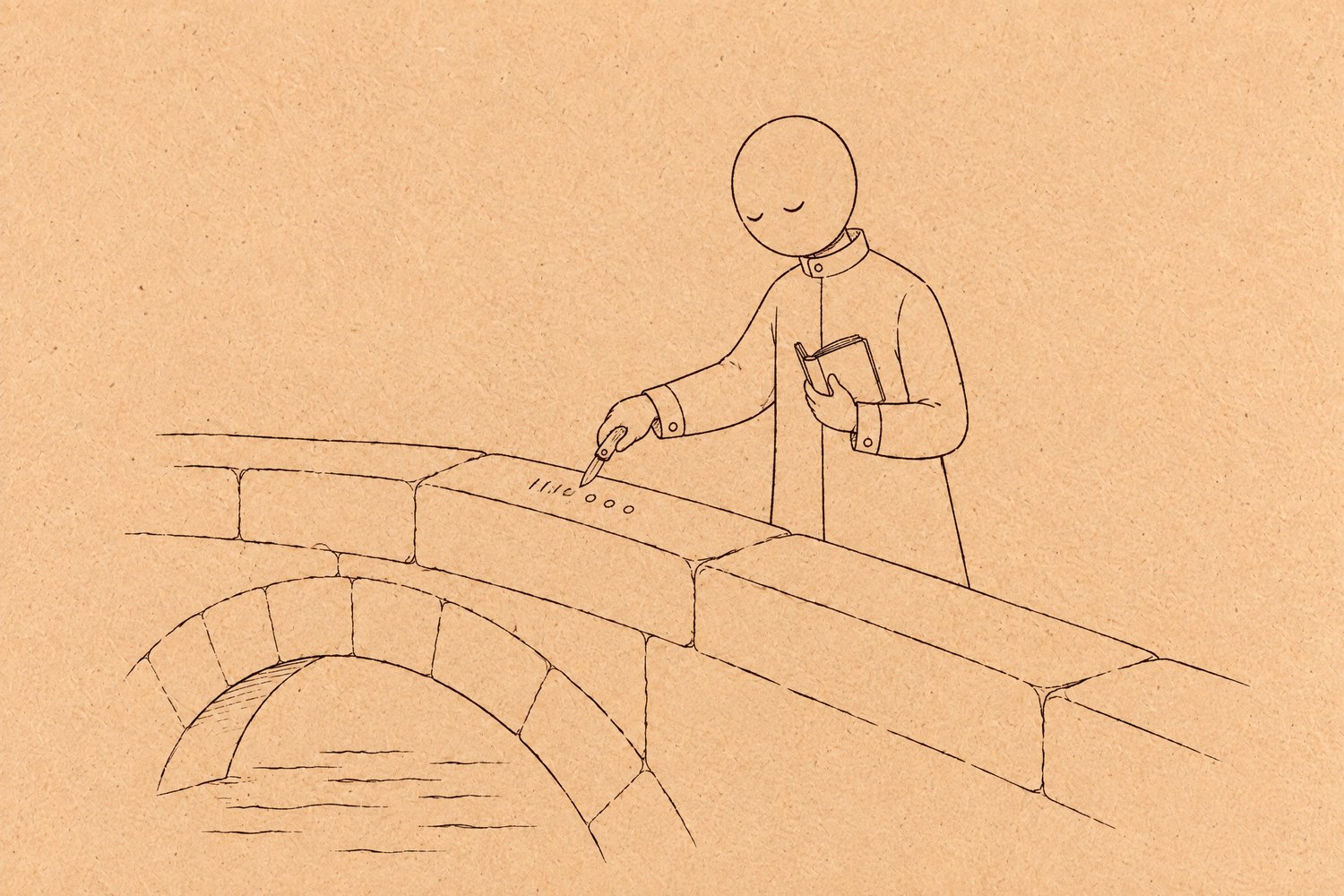
On October 16, 1843, the Irish mathematician William Hamilton was walking with his wife along a canal in Dublin, on his way to a meeting. He had been stuck at his desk on the same math problem for years. His wife talked to him now and then, he later wrote, but under the conversation his mind kept running. Then, as they came to a bridge, the whole answer surfaced.
He pulled out a notebook on the spot and wrote it down. Then, unable to resist, he carved the formula into the stone of the bridge with a knife. A plaque marks the spot today, and every year on October 16, mathematicians gather to walk the same path. People remember the carving in the stone. But the first thing he reached for was the notebook.
Good ideas show up in the shower and on walks, not at the desk
Everyone knows the idea that won't come at the desk and then shows up in the shower or on a walk. Hamilton isn't a one-off. Charles Darwin walked the same gravel path near his house every morning and afternoon, and reportedly kicked a stone aside at each lap to keep count. Ideas that arrive in the shower have been studied under the name "the shower effect." And it's just as common for one of those ideas to be gone by the time you reach for a towel.
Why those moments? The usual explanation is that you've cleared your head. The research says something slightly different. Good ideas showed up not when the mind was empty, but when it was moderately busy.
Walking increases idea output by about 60 percent — the Stanford study
In 2014, a Stanford research team had the same people generate ideas twice, once sitting and once walking. The task was to list as many new uses as possible for an ordinary object, like a button or a tire, in four minutes. While walking, 81 percent of participants produced more ideas than they had while sitting, and the average increase was around 60 percent. Oppezzo & Schwartz, 2014. 176 participants across four experiments.
The same study found three more things.
- Walking on a treadmill facing a blank wall worked as well as walking outside. The scenery wasn't the factor. Walking was.
- The effect lasted for a while after people sat back down.
- On problems with a single right answer, walking made people slightly worse. Walking helped with coming up with ideas, not with picking or refining them.
The condition isn't "empty." It's "moderately busy."
Good ideas in the shower or on a walk come from a mind that is moderately busy, not from a mind that has been emptied. Two separate studies point the same way.
In a 2012 study at the University of California, Santa Barbara, participants worked on an idea problem and then took a break. The groups that did nothing during the break, or did a demanding task, did not improve. Only the group given a light, simple task came back with more ideas. Baird et al., 2012. Replications of this result were mixed, which is why the 2022 study below redesigned it.
In 2022, a team at the University of Virginia tested it again under the title "the shower effect," using videos instead of showers. During the break, one group watched three minutes of people folding laundry. Another watched a moderately entertaining movie scene. The laundry group came up with fewer original ideas than the movie group. The sweet spot, in the researchers' words, is a state loose enough for thoughts to wander but not so loose that attention dissolves. Irving et al., 2022. 340 participants across two experiments. The paper notes that video stood in for an actual shower.
Showering, walking, washing dishes. That's about the right amount of busy. Your body has a job, but it doesn't take your whole mind. The mind that was straining at one problem at the desk loosens up. The good idea didn't appear out of nowhere at that moment. As Hamilton put it, the thought that had been running underneath finally came into view. The first habit is making room for that kind of time once a day.
You can only hold on to an idea you notice
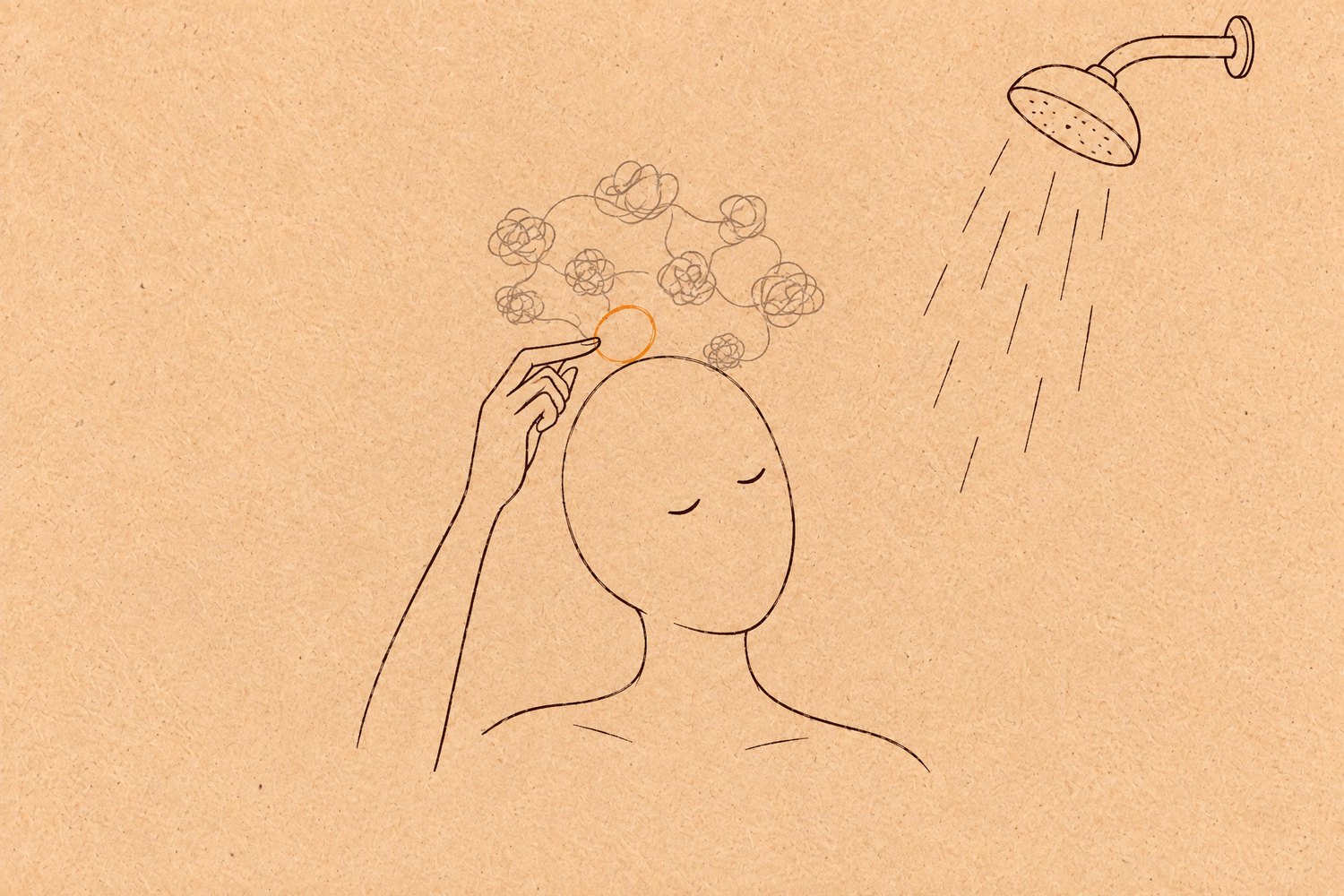
An idea you don't notice is an idea you can't keep. That's why the good idea from the shower is gone by the time you reach for the towel. The usual advice is to put a waterproof notepad in the shower. Fair enough, but it skips a step. You can only write something down after you've noticed it surface. That's where the second habit lives.
The thoughts floating around while you shower are, in other words, your mind wandering. Good ideas come mixed in with the rest. And while the mind is wandering, people often don't know it. In a study where readers were interrupted and asked "what were you just thinking about?", a good share of them had been somewhere else entirely without realizing it. Schooler et al., 2004. A good idea can pass right through, and if you don't notice it passing, you can't catch it.
The part of Hamilton's story that matters isn't that the answer came. It's what he did next. He stopped and took out his notebook. The carving in the bridge is what that moment of noticing left behind. Everything in this post about his wife, the notebook and the stone comes from a letter he wrote to his son 22 years later. The man who caught the moment also wrote it down.
Next time something surfaces in the shower, you can try saying two words to yourself before you reach for the towel: "There's one." The note comes after.
You can build this ability with three to five minutes of practice a day
The ability to notice a thought the moment it surfaces isn't something you're born with. It's a skill you build with three to five minutes of practice a day, in ordinary life. All it takes is your mind wandering and you noticing it, over and over. The easiest way to practice is to count your breaths. Even when you're only trying to count, your thoughts wander within seconds, so you get dozens of chances to notice in a few minutes.
The method is simple. Close your eyes and silently count one number per breath. One, two, three. Before long a thought comes up and you lose count. At some point you notice: oh, my mind wandered. Then you go back to the number you were on. If you were at seven, you pick up at eight. If the thought that came up was a good one, write it down when you're done. This is mindfulness meditation.
Meditation, too, is usually described as emptying your mind. Count a few breaths and you'll see that's not what happens. The thoughts don't empty out. There's only one thing you do: notice that a thought has come up, and go back to the number. Letting a shower idea slip past and taking a long time to notice you've lost count come down to the same skill. And the moment you notice, the mind that was stuck on one problem steps back from it. A walk loosens a mind that's been straining at the desk. Noticing and coming back can loosen it too.
Meditation is practice in noticing your own thoughts, and that can carry into real life, including moments like these. It isn't just some old-fashioned thing. There's a reason it has lasted three thousand years.
On your own, you tend to notice you've wandered only long after the fact. So I built True Meditation, an app that tells you the moment it happens. With your eyes closed, you silently count a number, tap the screen twice with your thumb, and take one breath. When your mind wanders, the rhythm of your taps drifts, and the app reads that drift and gives you a small vibration. You find out on that very breath, not minutes later. On a day with no time for a walk, the three minutes you spend waiting for a coffee are enough.
The few seconds after you turn off the water and before you reach for the towel. That's your bridge.
In short
What sets people who have a lot of good ideas apart isn't intelligence. A 2021 analysis of 30 studies found a correlation of only 0.16 between intelligence test scores and creative achievement. The difference is two habits. The first is spending time away from the desk with the mind only moderately busy. In a Stanford study, 81 percent of participants produced more ideas while walking than while sitting, and two other studies found that only people who did something light and simple during a break came back with more ideas. Ideas running underneath come into view not when the mind is empty, but when it's moderately busy.
The second habit is noticing an idea the moment it surfaces, so you can hold on to it. That's what the mathematician William Hamilton did in 1843 when an answer came to him on a walk and he wrote it in his notebook and carved it into a bridge. Noticing is a skill you can train. Mindfulness meditation, where you count your breaths, notice you've wandered and return to your number, is exactly that training.
True Meditation isn't an app you listen to. It's an app for doing mindfulness meditation yourself — practice in noticing your own thoughts, built into an app. It's free on the App Store and Google Play.
Related reading
- When Your Mind Won't Stop Racing, Emptying It Is the Wrong Move — why emptying doesn't work, and what noticing is
- You Rested Your Whole Lunch Break. Why Are You More Tired? — another case where how you use a break decides the rest of the day