Why Online Lectures Don't Sink In — It's Not About How Smart You Are
Harvard students watched the same 21-minute online statistics lecture. On the test afterward, their scores ranged from 68 to 90, depending on the group they were in.
The experiment was run by a Harvard research team in 2013. Students watched an intro to statistics lecture split into four parts of about five and a half minutes each, and they were divided into three groups. One group simply watched the lecture straight through. Another got questions on what had just been covered, with the answers already filled in, to read at the end of each part. The third took those same questions as a short quiz. On a final test covering the whole lecture, the group that just watched scored 68, the group that read the answers 76, and the quiz group 90.
Same school, same lecture, same 21 minutes.
A 22-point gap that brainpower alone doesn't explain.
The researchers were measuring one more thing during the lecture. At one random point in each part, they asked without warning: "Is your mind wandering right now?" The video kept playing, and students marked "yes" or "no" on a sheet beside them while they listened. So did those answers line up with the 22-point gap? Szpunar, Khan & Schacter, 2013. Second experiment, 48 students, each asked four times. Scores are percent correct.
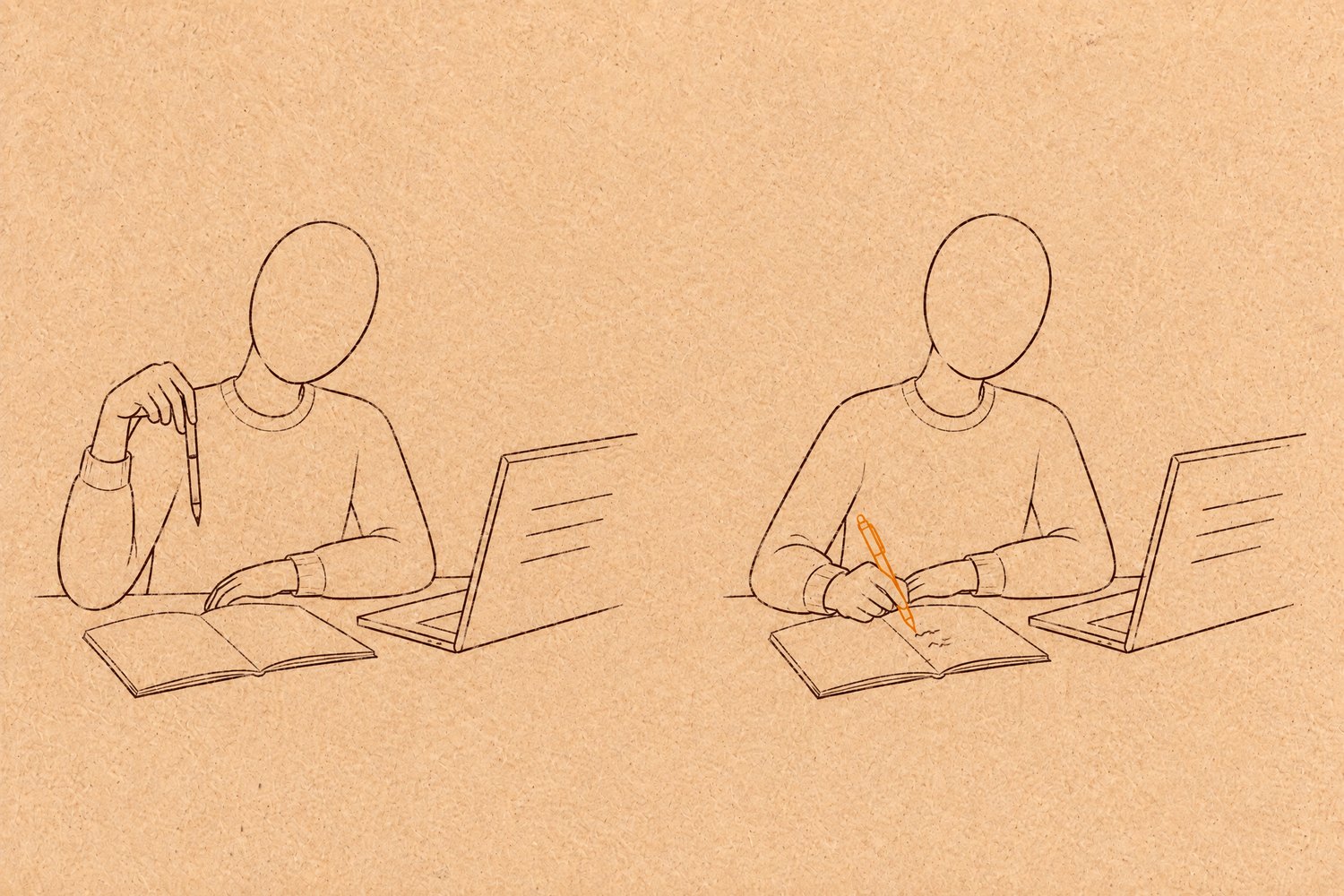
If an online lecture doesn't make sense, it may not be your brain
When an online lecture doesn't make sense, most people blame their brain. But in this study, students from the same school watched the same lecture, their scores ended up 22 points apart, and mind-wandering rose and fell with them. In the group that just watched, 41 percent of the answers to the surprise check-in were "yes." In the quiz group it was 19 percent, less than half.
You might think Harvard students do fine even when their minds wander. This study shows the opposite. Even among Harvard students, the group whose minds wandered more knew less of the lecture. Their eyes were on the screen and the lecture was in their ears, but whatever was explained while they were somewhere else never sank in. And you can't understand what you never took in. The quizzes also gave students practice recalling the material, so mind-wandering isn't the whole 22 points.
The group worth a closer look is the one that read the answers. They saw exactly the same questions as the quiz group, only with the answers already there. They scored a little higher, 76, but 39 percent of their answers were still "yes," almost the same as the students who just watched (41 percent). Seeing the same material twice didn't reduce mind-wandering.
When it came to mind-wandering, reading the answers didn't help. Answering the questions yourself did. Where did the difference come from?
Why quizzes cut mind-wandering in half during an online lecture
The Harvard team's explanation was that quizzes during a lecture keep students' attention on the material, and steer them toward things like taking notes instead of zoning out. The quizzed students did take about three times as many notes. Having students read the same questions and answers at the same points did not produce this change.
Here's another way to see it. When you face a question, it becomes obvious whether you were actually following the lecture a moment ago. If no answer comes, you realize: oh, I totally zoned out there. Reading the answers has no moment like that. Everything seems to make sense, and the part you missed slips by without you knowing you missed it.
But after the lecture is over, you still have the textbook and the problem sets. Nobody quizzes you while you read. What happens then?
You spend 20 to 30 percent of your reading time thinking about something else
The mind wanders often during reading too. A 2021 review of research on mind-wandering while reading found that people spend about 20 to 30 percent of their reading time thinking about something else, and the more their minds wander, the less they understand. The eyes keep moving along the lines, but the content isn't sinking in. D'Mello & Mills, 2021.
The harder the text, the more of that time there is. In an experiment where the same people read both easy and difficult texts, their minds wandered more often on the difficult ones, and it hurt their comprehension more. Textbooks and technical reading, where every sentence carries weight, are exactly that kind of text. Feng, D'Mello & Graesser, 2013.
And readers themselves often don't know it's happening. In one experiment, people read the opening chapters of Tolstoy's War and Peace and were told to press a button whenever they noticed their mind wandering. Every so often, a researcher also asked: "Is your mind wandering right now?" Some of those times, people answered yes even though they hadn't pressed the button. They had been somewhere else without realizing it. Schooler et al., 2004.
When a lecture doesn't make sense, the usual advice is to find a teacher whose style clicks with you, preview the material first, or go back and review the basics. All good advice. But no matter who's teaching or how well, an explanation that goes by while your mind is somewhere else is an explanation you never heard.
Online lectures have a rewind button.
The problem is knowing when to press it.
As long as you don't know your mind has wandered, you don't know there's anything to rewind. And when you study on your own, there's no one giving you a quiz every five minutes.
So what do you do on your own? It isn't about a better study schedule or more willpower. What you need first is to notice for yourself that your mind just wandered, and there's a way to practice that kind of noticing.
Mindfulness meditation is practice in noticing when your mind wanders
The ability to notice for yourself that your mind has wandered off the material can be practiced, and that practice is mindfulness meditation. Mindfulness meditation is the practice of noticing thoughts as they come up.
What you do is simple. Close your eyes and rest your attention on the feeling of your breath. Before long another thought comes up, and soon you're following it. At some point you notice, oh, my mind wandered, and you come back to the breath. Noticing and coming back is all there is to it. Getting rid of thoughts isn't the goal. Thoughts keep coming, and each one is another chance to notice.
The word meditation can sound like an old practice with nothing to do with studying for exams. It isn't just some old-fashioned thing. There's a reason it has lasted three thousand years.
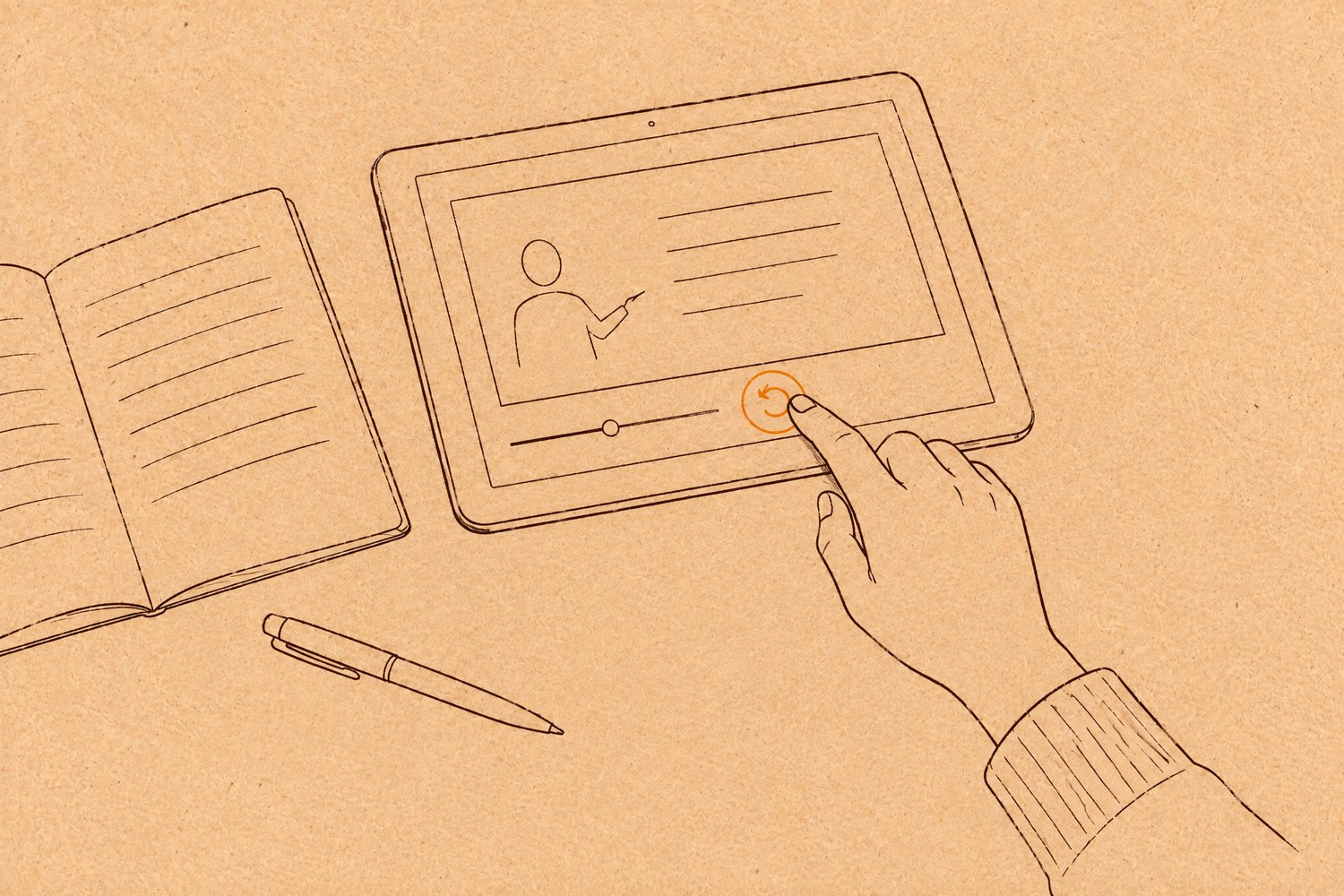
Catching yourself in a lecture with wait, what did they just say? and catching yourself mid-meditation after your mind has wandered are the same act of noticing. In meditation you come back to the breath. In an online lecture, you come back with the rewind button. The sooner you notice, the less you have to rewind.
On your own, you tend to notice you've wandered only long after the fact. So I built True Meditation, an app that tells you the moment it happens. With your eyes closed, you silently say a number to yourself, tap the screen twice with your thumb, and take one breath. When your mind wanders, the rhythm of your taps drifts, and the app reads that and gives you a small vibration. Do it for three minutes before you start a lecture.
Next time you're watching a lecture and think wait, what did they just say?, before you beat yourself up,
say "missed that" in your head, and rewind ten seconds.
That's where it starts.
In short
When online lectures or books don't make sense, the problem often isn't your brain. It's that your mind was somewhere else when the explanation went by. In a 2013 Harvard study, students who watched the same 21-minute online statistics lecture scored anywhere from 68 to 90 on the test afterward. Among students who simply watched, 41 percent of answers to a surprise "is your mind wandering?" check were yes. Students who read the questions with answers were at 39 percent, barely lower, and only students who took short quizzes during the lecture dropped to 19 percent. When people read, 20 to 30 percent of that time goes to other thoughts. The more the mind wanders, the less they understand, and they often don't notice.
What helps when studying alone is the ability to notice quickly, on your own, that your mind has wandered. That is exactly what mindfulness meditation trains: rest your attention on the breath, notice when your mind wanders, and come back.
True Meditation isn't an app you listen to. It's an app for doing mindfulness meditation yourself — practice in noticing your own thoughts, built into an app. It's free on the App Store and Google Play.
Related reading
- How to Stop Procrastinating — why putting off studying isn't only a willpower problem
- When Your Mind Won't Stop Racing, Emptying It Is the Wrong Move — the difference between emptying your mind and noticing