Smart but Zoning Out in Class? Have Them Write One Thing in Their Notebook
The teacher is at the board. "Mitochondria make ATP. ATP is the energy cells run on."
The kid gets it right away. Just as fast, a question pops up. If there's no ATP, does the cell die on the spot? What about brain cells? How long can a brain go without oxygen? Wait, then how do free divers hold their breath for so long?
From the outside, it looks like zoning out. But the kid's mind isn't blank. If anything, they're thinking hard. Then they look up, and the teacher is already explaining the next idea.
It's a scene that plays out in classrooms all the time. Parents of kids like this often say, "My kid is smart, but the grades just aren't there." Most people smile and move on. Every parent thinks their kid is smart.
But for some kids, it's actually true.
And for those kids, writing one thing in their notebook might be the answer.
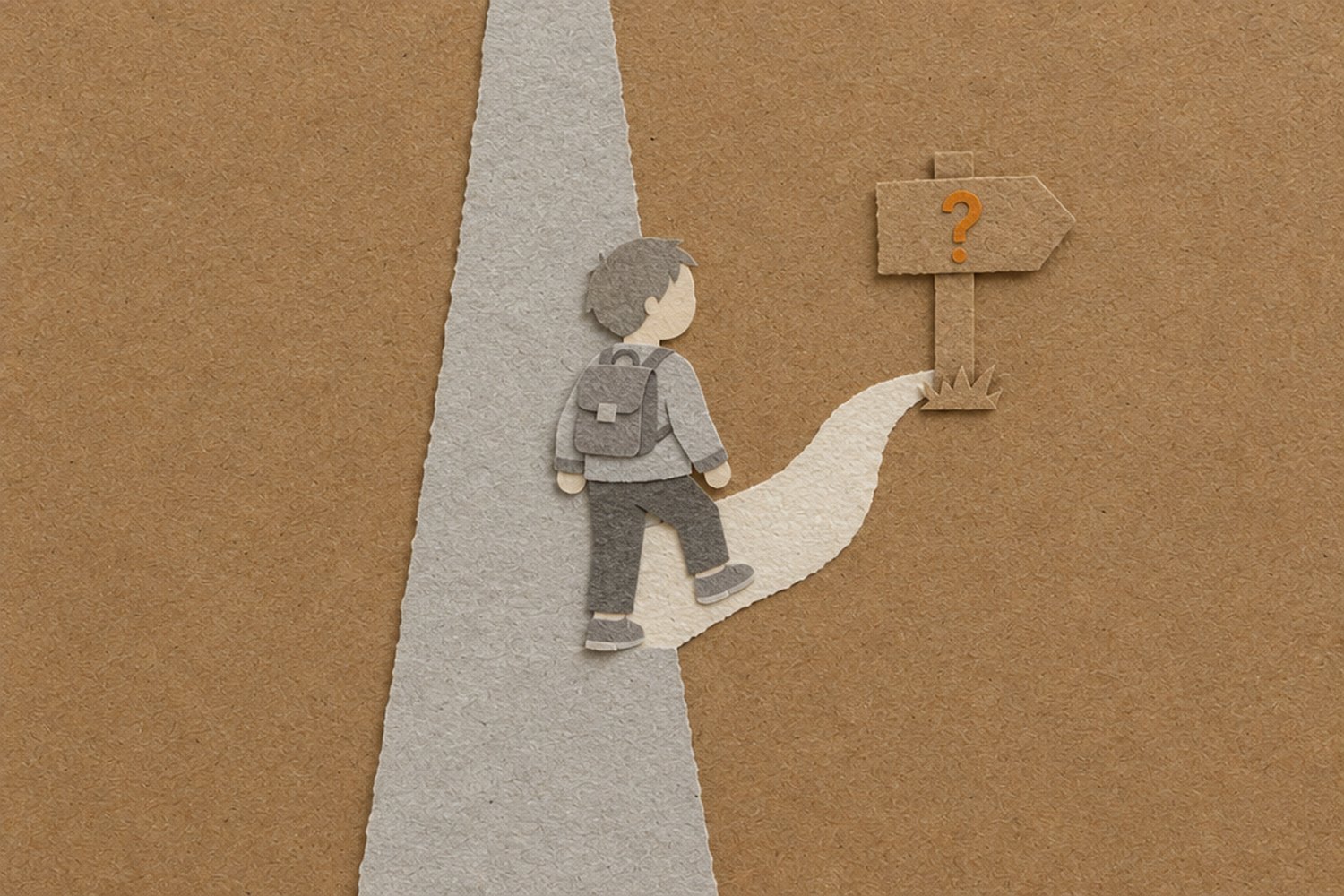
What happens in class when a smart kid gets bad grades
Some smart kids with bad grades are quick to understand the lesson. As soon as they understand, a question comes up, and while they follow that question, they miss the next part of the explanation. Their thinking didn't stop. It just went somewhere other than where the teacher was going.
Class doesn't wait. When you're reading on your own, you can wander off, come back, and reread from that line. A lesson doesn't stop and wait for the kid to come back, and whatever was said in between is simply gone. In subjects where each explanation builds on the last, one missing piece can throw off everything after it.
Kids' minds wander more often than you might think. A research team in the UK told a story to 97 children aged 6 to 11 and stopped every so often to ask, "What were you just thinking about?" About one in four times, the kids said they'd been thinking about something else. And the kids whose minds wandered more often remembered less of the story. Cherry, McCormack & Graham, 2022, Journal of Experimental Child Psychology. It was a listening task, not a classroom lesson, and the result shows the two went together, not that one caused the other.
So when a kid like this gets bad grades, it may not be about brains or effort.
They didn't miss the lesson because they weren't thinking. They missed it because they followed a thought too far.
Frequent mind-wandering in class doesn't, on its own, mean ADHD or any other diagnosis. If you're worried, talking to a professional comes first.
So is curiosity the problem? Should kids be taught to hold back every time a question comes up?
Why "Stop daydreaming and pay attention" may not be the answer
Telling a kid to "stop daydreaming and pay attention" and shut down every thought that comes up in class may not be the answer. In a study where 182 adults watched a statistics lecture video (Kane et al., 2017), people whose minds wandered more learned less, but those whose wandering thoughts stayed connected to the lecture topic actually learned more.
In one study, 182 adults watched an intro to statistics lecture video and were asked at random moments, "What were you just thinking about?" The more someone's mind wandered during the lecture, the less they learned. But not all mind-wandering was the same. But among those wandering thoughts, the ones about something connected to the lecture actually went with learning more. Kane et al., 2017. A study of adults, and the result shows the two went together, not that one caused the other.
The question the kid just had wasn't a useless thought either. Going from ATP to brain cells to free divers is a thought that stayed tied to the lesson and went deeper. That kind of thinking isn't what needs to stop.
The problem is somewhere else. While the kid was following that thought, they didn't realize they had left the lesson.
Being smart and knowing where that smart mind is right now are two different things.
So can a kid keep the curiosity and still not miss the lesson?
When a question comes up, put a question mark in the margin
For a kid who chases questions in class and misses the explanation, the simplest way to keep the curiosity without missing the lesson is to write a question mark in the margin of the notebook the moment a question comes up, and go right back to following the explanation. After class or during review, they come back to that question mark and dig in.
That "one thing" from the beginning is this question mark. If "How long can a cell last without ATP?" pops into the kid's head, they don't go looking for the answer right then. They just write this in the margin:
?
And they follow the teacher's explanation to the end.

It isn't giving up on curiosity. It's moving curiosity to a different time. In class, they get the overall flow of what's being taught that day. During review, they dig into what they were curious about. If they chase a question in the middle of class, no matter how good the thought, they lose the explanation that came after it. The question mark is a bookmark that says, "Come back here." This isn't a specific study method tested in research. It's a practical suggestion from this post.
That's the whole method. But when you actually try it, one moment turns out to be hard.
To write the question mark, the kid first has to notice, "I'm drifting into a different thought right now."
You don't notice your mind wandering while it happens, only after
Most people don't notice the moment their mind starts to wander. They notice later, after they've been gone a while. Nobody starts with "Okay, time to think about something else." You snap out of it, and it's "Wait, what is the teacher talking about?"
Researchers who study mind-wandering put it the same way: people aren't always aware that their mind is wandering, and only notice now and then. Schooler et al., 2011, Trends in Cognitive Sciences. The chance to write the question mark only comes at one of those moments of noticing.
So the kid who misses less of the lesson may not be the one who never wanders. It may be the one who notices sooner and comes back. Nobody can stop their mind from ever wandering, but the time it takes to notice can get shorter.
The catch is that this kind of noticing is hard to practice during class. The lesson keeps going while you practice. So the noticing and coming back gets practiced on its own, outside of class.
Mindfulness meditation is a way to practice noticing and coming back
Noticing that your mind has wandered and coming back to what you were doing can be practiced, and that practice is mindfulness meditation. Mindfulness meditation isn't about getting rid of thoughts. It's about noticing a thought that has come up, and coming back.
What you do is simple. Close your eyes and rest your attention on the feeling of your breath. Before long another thought comes up, and soon you're following it. At some point you notice, oh, my mind wandered, and you come back to the breath. A thought coming up isn't a failure. Every time one comes up, you get another chance to notice and come back.
Put this next to what happens in class, and the two line up almost exactly.
| In meditation | In class |
|---|---|
| The feeling of the breath | The teacher's explanation |
| A thought that comes up | A question that comes up |
| Noticing, oh, my mind wandered | Noticing, oh, I've left the explanation |
| Coming back to the breath | Writing a question mark and coming back to the explanation |
In meditation you come back to the breath. In class, you come back with a question mark.
There's research on this practice too. College students were split into two groups, and only one group took a two-week mindfulness class. That group's minds wandered less while they worked on test questions, and their reading comprehension scores went up. Scores rose most for students who had been easily distracted to begin with. The researchers put that down to their minds wandering less. Mrazek et al., 2013. A small two-week study of college students, so it can't tell us whether kids would see the same results.
That doesn't mean meditation raises grades. What the study showed is that the less their minds were pulled away, the more they stayed with the problem in front of them.
Meditation can sound like something hard, where you sit for a long time and empty your mind. It isn't. You don't need a cushion, a quiet room or a lot of time. Even five minutes a day builds up the ability to notice when your mind has wandered, little by little.
When a stray thought comes up in class, here's how to come back
When a question or a stray thought comes up in class, a kid can get back to the lesson in three steps. First, notice that they've drifted away from the teacher's explanation. Second, write a question mark in the notebook. Third, go back to following the explanation. The hardest step, the first one, can be built separately through mindfulness meditation, which is practice in resting attention on the breath, noticing when the mind wanders, and coming back.
Some smart kids with bad grades understand an explanation quickly, then follow the question it sparks and miss what comes next. The problem isn't the thought itself. It's not realizing they've left the lesson while they follow it. So what they need isn't the ability to stop thinking. It's the ability to notice the moment they've left and come back to the lesson.
With steady mindfulness practice, when a question or some other thought comes up in class, they won't stay lost in it for long. They'll notice quickly. In that moment they write a question mark in their notebook, think "Okay, follow the whole lesson first," and go back to the explanation.
It isn't only in class, either. The same thing happens when they do homework problems or read on their own. When another thought comes up in the middle of a problem, they notice, write a question mark, and go back to the problem. When they study alone, no one tells them their mind has wandered, so a long stretch can go by on other thoughts. That's where noticing matters even more.
That's why I recommend mindfulness meditation for kids like this.
Meditating alone, though, a kid tends to notice they've wandered only long after the fact. So I built an app that tells them the moment it happens. I'm the developer of True Meditation, the app behind this site.
Here's how your kid uses it. They close their eyes and silently count 1, 2, 3… as they breathe. For each number, they tap the screen twice with their thumb, then take one breath. When their mind wanders, the rhythm of the taps goes uneven, and the app detects that and gives a small vibration. Noticing that vibration, thinking oh, my mind wandered, and going back to the count is the same move as writing a question mark in class and going back to the explanation. Five minutes a day, before they start studying, is enough.
Next time your kid seems "smart, but the grades just aren't there," instead of "Stop daydreaming," you can try saying this:
"Being curious is good. For now, just put a question mark, and we'll look it up together after class."
In short
Some smart kids get bad grades not because of brains or effort, but because they follow a question that comes up in class and miss the explanation that comes next. In a lecture-video study of 182 adults (Kane et al., 2017), wandering thoughts connected to the lecture actually went with learning more. So the thinking isn't the problem; not realizing you've left the lesson is. The question can wait as a question mark in the notebook until review. The ability to notice that you've left can be practiced through mindfulness meditation: resting attention on the breath, noticing when the mind wanders, and coming back. Noticing, writing a question mark and coming back works the same way when doing homework problems or reading alone as it does in class.
True Meditation isn't an app you listen to. It's an app for doing mindfulness meditation yourself — practice in noticing your own thoughts, built into an app. It's free on the App Store and Google Play.
Related reading
- Why Online Lectures Don't Sink In — It's Not About How Smart You Are — why the minutes your mind wanders during a lecture don't turn into understanding
- Mindfulness Meditation Isn't About Getting Rid of Thoughts — the difference between getting rid of thoughts and noticing them